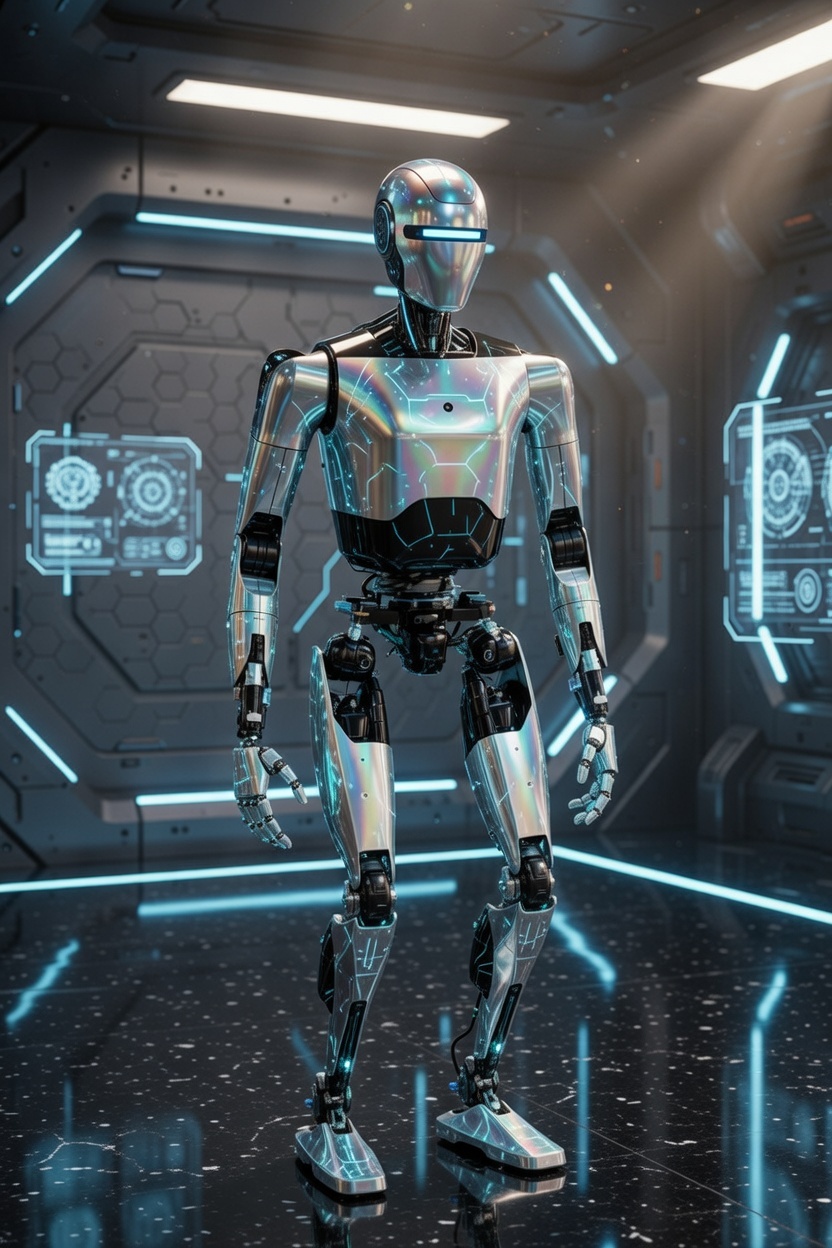
The humanoid robot revolution has a bottleneck, and it isn't motors or sensors. It's intelligence. The models that can reason, plan, and understand language are too large, too power-hungry, and too slow for a body that needs to react in real time on a battery. SWAN changes that equation.
The Embodied Intelligence Gap
We are living through an extraordinary convergence. On one side, humanoid robots are advancing rapidly — Boston Dynamics, Tesla Optimus, Figure, Unitree, Agility Robotics — with hardware platforms that can walk, manipulate objects, and navigate real-world environments. On the other side, large language models have achieved remarkable reasoning capabilities — scientific understanding, mathematical problem-solving, code generation, and nuanced language comprehension.
The problem is putting these two together.
A frontier LLM like Qwen3.5-397B in full precision requires over 800 GB of memory and a multi-GPU data centre to run. A humanoid robot has perhaps 16–64 GB of on-board memory, a power budget of 20–100 watts for compute, and a latency requirement measured in milliseconds, not seconds. The gap between what these models need and what robotics hardware provides is enormous.
This is the embodied intelligence gap — and intelligent quantization is how we close it.
Why Robots Need Reasoning, Not Just Reflexes
Early approaches to robot intelligence used small, specialised models — a vision model for object detection, a separate model for path planning, another for grasp estimation. These work for narrow tasks in controlled environments. But a humanoid robot operating in an unstructured human environment needs something fundamentally different:
- Multi-step reasoning. "The mug is behind the laptop, which is on the desk that's partially blocked by the chair." A robot needs to plan a sequence of actions, not just detect objects.
- Natural language understanding. "Can you grab me the blue one? No, the other blue one." Human instructions are ambiguous, contextual, and constantly changing.
- Common-sense physics. Understanding that a full mug of coffee will spill if tilted, that a fragile object needs a gentler grip, that a door handle works differently from a drawer pull.
- Safety reasoning. Recognising that a child walking into the workspace changes the entire risk calculus. Understanding when to stop, ask for clarification, or refuse a dangerous instruction.
These capabilities exist today — in models with hundreds of billions of parameters. The challenge is making them small enough and fast enough to run on-board.
The Quantization Imperative
Quantization — reducing the numerical precision of model weights from 16-bit to 4-bit or lower — is the single most important technique for bringing frontier intelligence to edge devices. A 4× reduction in model size directly translates to:
| Metric | BF16 (Full) | SWAN 4-bit Mixed | Improvement |
|---|---|---|---|
| Memory Footprint | 800+ GB | ~200 GB | 4× smaller |
| Memory Bandwidth | Baseline | ~4× less | 4× faster inference |
| Power Consumption | Baseline | Significantly reduced | Longer battery life |
| Latency | Seconds | Sub-second | Real-time capable |
But uniform quantization — reducing every parameter to the same bit-width — is a blunt instrument. It treats the parameters that encode safety reasoning identically to the parameters that encode rarely-used trivia. For a robot, this trade-off is unacceptable. You can tolerate slight degradation in poetry generation; you cannot tolerate degradation in understanding "stop, there's a person behind you."
Why SWAN Is Built for Robotics
SWAN (Statistical Weight Analysis for N-bit allocation) solves exactly this problem. Instead of compressing every parameter equally, SWAN analyses each weight tensor across four dimensions of sensitivity and assigns precision intelligently:
Preserve What Matters, Compress What Doesn't
SWAN's multi-metric analysis identifies the 4–5% of parameters that carry disproportionate importance for model quality — typically attention mechanisms, expert routing gates, and early/late layer projections. These get 8-bit or 16-bit precision. The remaining 95% compress to 4-bit or even 2-bit with minimal quality loss.
For robotics, this means the reasoning pathways that handle spatial understanding, instruction parsing, and safety logic retain high fidelity, while the vast bulk of parameters that handle general knowledge compress aggressively.
No Calibration Data Required
This is critical for robotics applications. Calibration-based quantization methods like GPTQ and AWQ require representative samples of the inputs the model will process. But what does "representative input" look like for a humanoid robot? Kitchen conversations? Warehouse instructions? Emergency scenarios? The deployment distribution is inherently unpredictable and ever-changing.
SWAN is entirely data-free. It analyses the mathematical structure of the weights themselves — spectral concentration, kurtosis, noise amplification, reconstruction error — making it domain-agnostic by design. A SWAN-quantized model works equally well whether the robot is in a hospital, a factory, or a home.
13 Minutes to a New Brain
Robotics development cycles are fast. Teams iterate on model architectures, fine-tune for specific tasks, and swap between base models frequently. SWAN's 13-minute analysis pipeline means quantizing a new model variant is trivially fast compared to calibration methods that take hours. This speed enables rapid experimentation with different model-size trade-offs for different robot form factors and deployment scenarios.
The Hardware Landscape for Robot Brains
The compute hardware available for humanoid robots is evolving rapidly, and SWAN-quantized models map naturally to this landscape:
| Platform | Memory | Power | SWAN Model Size |
|---|---|---|---|
| NVIDIA Jetson Thor | Up to 128 GB | ~100W | 70B–100B class models |
| Qualcomm Cloud AI 100 | 32–64 GB | ~75W | 30B–70B class models |
| Apple M-series (embedded) | Up to 512 GB | ~30W | 400B+ class models |
| Edge NPUs (future) | 16–32 GB | ~15W | 8B–30B class models |
SWAN's ability to produce models at different average bit-widths — from aggressive 2-bit compression for the most constrained platforms to quality-preserving 4.3-bit for high-memory systems — means the same analysis pipeline serves the entire hardware spectrum.
Intelligence Density: The Metric That Matters
For robotics, the relevant metric isn't raw model size or even perplexity. It's intelligence density — how much reasoning capability you get per byte of memory and per watt of power.
SWAN dramatically improves intelligence density by spending bits where they generate the most reasoning value. Consider the numbers from our Qwen3.5-397B evaluation:
- 96.0% ARC-Challenge (science reasoning) at just 4.31 average bits per parameter
- 88.7% GSM8K (mathematical reasoning) — critical for spatial and physics computations
- 77.1% MMLU-Pro (expert knowledge) — broad understanding for unstructured environments
- 78.7% HumanEval (code generation) — relevant for robots that need to interpret structured instructions
These aren't toy model numbers. This is frontier-class reasoning compressed to fit on commodity hardware. For robotics teams, this means the difference between a robot that can follow simple pick-and-place instructions and one that can reason about multi-step tasks in complex environments.
The Cascade Architecture
The most promising architecture for robot intelligence isn't a single model — it's a cascade of SWAN-quantized models at different sizes and specialisations:
SWAN enables this cascade because it produces optimised models at every scale — from aggressively compressed small models for the reflex layer to quality-preserving large models for the reasoning layer — all from the same automated pipeline, all without calibration data.
From Data Centre to Body
The trajectory is clear. Today, the most capable humanoid robots send sensor data to cloud servers for processing and receive action commands back. This works in demonstrations but fails in production: latency spikes, network outages, and bandwidth limitations make cloud-dependent robots unreliable in real-world deployments.
The future belongs to robots with on-board intelligence. SWAN's data-free, fast, and hardware-agnostic approach to quantization is a critical enabler of this transition. As compute hardware for edge devices continues to improve — more memory, lower power, faster inference — SWAN-quantized models will scale with it, always maximising the intelligence that fits within the hardware envelope.
The humanoid robot revolution isn't waiting for better motors. It's waiting for smaller, smarter brains. SWAN is building them.
Code and data at github.com/baa-ai/swan-quantization.
Need deep AI expertise to get your models into production?
Black Sheep AI brings deep expertise in model quantization, edge deployment, and embodied AI systems. We help robotics teams bridge the gap between frontier model capabilities and on-device hardware constraints.
Talk to Our Team