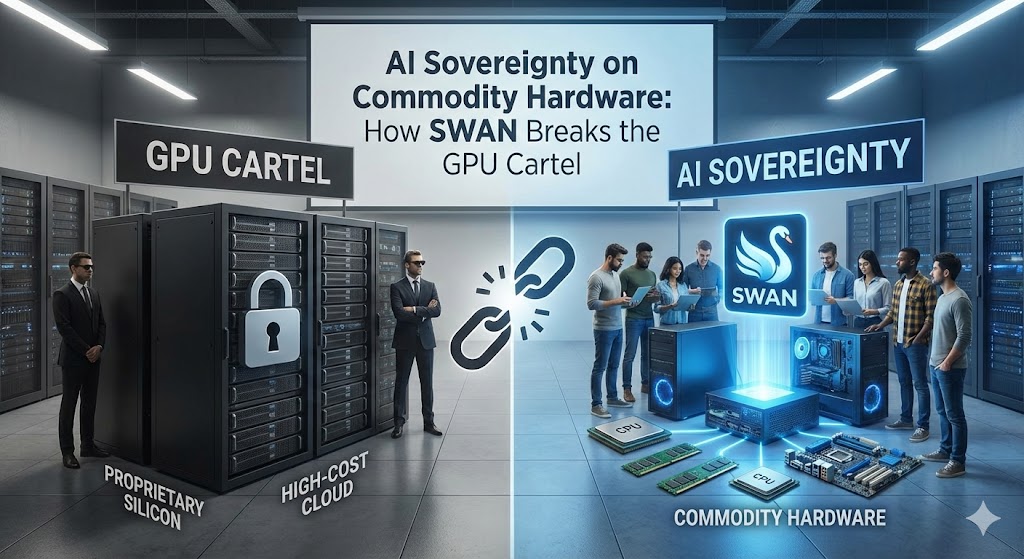
The ability to run frontier AI should not require permission from a hyperscaler, an allocation from NVIDIA, or a seven-figure cloud contract. SWAN quantization makes it possible to deploy 400-billion parameter models on hardware you can buy at an Apple Store. This isn't just a technical achievement — it's a redistribution of power.
The Concentration Problem
As of early 2026, access to frontier AI capability is concentrated in a remarkably small number of hands. Running a state-of-the-art 400B+ parameter model at full precision requires:
- 4–8 NVIDIA H100 GPUs ($25,000–$40,000 each, if you can get them)
- A data centre with appropriate power, cooling, and networking
- Or a cloud contract with AWS, Azure, or Google Cloud at $25–50+/hour
This creates a structural dependency. Organisations that need frontier AI capability must either invest millions in infrastructure or rent it from one of three hyperscalers. Nations pursuing AI sovereignty face a bottleneck of GPU supply chains controlled by a single company. Startups and researchers compete for the same scarce GPU allocations as tech giants.
The open-source model movement solved the software side of AI access. Anyone can download Qwen3.5-397B, Llama 4, or DeepSeek. But downloading a model you can't run isn't access — it's a tease. The hardware side of AI access remains firmly gatekept.
SWAN breaks this gate.
The Alternative Hardware Path
Apple Silicon's unified memory architecture offers something no other consumer hardware does: up to 512 GB of high-bandwidth memory accessible to both CPU and GPU, in a package that fits on a desk and draws under 200 watts.
This hardware isn't designed for AI. Apple built it for video professionals, 3D artists, and software developers. But through an accident of architecture — unified memory that the GPU can directly access without PCIe bottlenecks — it happens to be extraordinary for large-model inference.
The missing piece was intelligent quantization. You can fit a 400B model into 512 GB, but only if you compress it smartly. That's SWAN's contribution.
What Sovereignty Actually Looks Like
AI sovereignty isn't just a geopolitical concept. It applies at every level — national, organisational, and individual. SWAN enables sovereignty at each:
National AI Independence
Countries outside the US-China GPU axis face a genuine strategic challenge: how do you build domestic AI capability when the hardware supply chain runs through Taipei, and the cloud infrastructure runs through Seattle? SWAN offers an alternative path: open-source models, commodity Apple hardware (available globally without export restrictions), and a quantization pipeline that runs locally. A university research group, a government agency, or a national lab can deploy frontier-class AI without touching a GPU cluster.
Organisational Autonomy
Every API call to a cloud AI provider creates three dependencies: on the provider's continued availability, on their pricing remaining affordable, and on their terms of service remaining acceptable. Organisations using SWAN-quantized models on local hardware eliminate all three. No vendor lock-in. No price increases. No unilateral policy changes. No data leaving the network.
For regulated industries, defence contractors, and organisations handling sensitive data, this isn't a preference — it's a compliance requirement that SWAN makes achievable.
Individual Empowerment
An independent researcher, a startup founder, or a journalist investigating sensitive topics can run a 400B parameter model on a Mac Studio. No cloud account. No API key. No audit trail visible to any third party. The model belongs to them, runs on their hardware, and answers to no one's content policy but their own.
The Economics of Liberation
The cost comparison between cloud-dependent and sovereign AI deployment is stark:
| Scenario | Cloud (H100 cluster) | SWAN on Mac Studio |
|---|---|---|
| Upfront Cost | $0 (pay-as-you-go) | ~$10,000 (one-time) |
| Monthly Cost (8h/day) | $6,000–$12,000 | ~$30 electricity |
| Annual Cost | $72,000–$144,000 | ~$360 + hardware |
| Break-even | — | ~1–2 months |
| Data Sovereignty | None | Complete |
| Vendor Lock-in | High | None |
A Mac Studio with 512 GB unified memory pays for itself within two months compared to equivalent cloud GPU costs. After that, frontier AI capability is essentially free — just electricity. For any organisation running AI inference at meaningful scale, the economic case for local deployment is overwhelming.
Quality Without Compromise
The sovereign path doesn't mean inferior AI. SWAN-quantized Qwen3.5-397B running on a Mac Studio achieves:
Running on a single Mac Studio · 199 GB · 4.31 avg bits · No internet required
96% science reasoning. 89% mathematical reasoning. 79% code generation. On a box that sits on your desk, costs less than two months of cloud GPU rental, and requires no internet connection to operate.
The Broader Shift
SWAN is part of a larger movement in AI — the decoupling of model capability from infrastructure dependency. Open-source models broke the software monopoly. Efficient quantization is breaking the hardware monopoly. Together, they create something genuinely new: frontier AI as a commodity.
This shift has consequences that go beyond cost savings:
- Research democratisation. A PhD student with a Mac can experiment with 400B parameter models. This was impossible two years ago without institutional GPU access.
- Innovation distribution. When frontier AI runs on commodity hardware, innovation can come from anywhere — not just organisations with GPU budgets.
- Resilience. Distributed AI capability on local hardware is inherently more resilient than centralised cloud dependency. No single point of failure, no single point of control.
- Privacy as a default. When the model runs locally, data privacy isn't a feature to negotiate — it's the architectural default.
Building the Sovereign Stack
The full sovereign AI stack is now available to anyone:
- Model: Open-source (Qwen, Llama, DeepSeek) — free
- Quantization: SWAN — open source, 13 minutes, no calibration data
- Framework: MLX — Apple's open-source AI framework
- Hardware: Mac Studio with M3/M4 Ultra — available at retail
- Connectivity: None required after initial download
Every component is either open source or commercially available without special arrangements. No enterprise sales calls. No GPU allocation waitlists. No cloud credit applications. Just download, quantize, run.
The GPU cartel still controls AI training. But for inference — the part that matters for deployment — the gate is open. SWAN is one of the keys that opened it.
Code and data at github.com/baa-ai/swan-quantization.
Need deep AI expertise to get your models into production?
Black Sheep AI helps organisations build sovereign AI capability — from model selection and quantization to deployment architecture and production operations. Deep expertise, no vendor lock-in.
Talk to Our Team